Showing posts with label flora. Show all posts

Tuesday, February 18, 2025

Cold Weather Flowers


Galanthus Snowdrops

Our cold weather has ended in northwest Washington. It reached 50 F today with misty rain. Given that I had a water venture via kyak I was glad for the warm up although it was 43 F with light rain when I started out.

I noted the above snowdrops on a morning walk about when the temperature was 18 F. They get a head start on the grass next to chunk of the British Columbia Coast Range brough by the last glacial period. 

On the same walk I noted Salix scouleriana in bloom in a sunny spot at the edge of the forest. 


This willow is a native tree. Further back in the forest there is willow that fell a few years ago. The tree was 60 feet tall before falling. But the tree is still alive and the willow patch has thus begun to expand.

During the cold period the patch of Helleborus that had been in full bloom before the cold had hunkered down in its shady north aspect location. 


But post cold the flowers had opened up again.


Tuesday, January 21, 2025

My Forest Enemy: Ilex aquifofium

While doing field work I come across what I have decided is a personal enemy on regular basis.

Eglish Holly (Ilex aquifolium)

I was able to pull this one out by the roots.

I at times visuzlize the Pacific Northwest forests in 10,000 years being a forest of holly. The holly shown above was in an old growth forest. I have come across holly in old forest areas ranging in elevation from the inland coastal areas to as much as 3500 feet in the Cascade Range. I have been digging it out of my own forest stand on regular basis, and when I can, I yank it out of the ground and stick it into a spot above the ground while traversing through the forest during a field ventures.  .

KUOW covered recent efforts to get this plant listed as a noxiuos weed (kuow.org/have-a-holly-noxious-christmas). The issue strikes me as a state government and ethics failure.  

Monday, January 29, 2024

Lodge Pole Transplants

I have observed that large swaths of Shaw Island and Lopez Island are covered with stands of lodge pole pine. The lodge pole appear to do well in silty glacial till soils. The glacial till is very dense and hard and has very low rates of permeability. The upper soil above the unweathered till is only about 1 to 2 feet thick. Hence, the upper soil layer becomes saturated in the winter. Lopez and Shaw Islands are within the rain shadow of the Olympic Mountains so the total rainfall results in the till becoming essentially desiccated in the summer. Another climate factor is the San Juan Islands area subject to periodic very cold temperatures associated with the Arctic outflow of air from the Fraser River to the northeast. The combination of wet winter ground, dry ground in the summer and high very cold wind is a good match for lodge pole.  

During a recent venture I came across lodge pole pines growing within a logging road on the steep upper northeast slope of Mount Constitution on Orcas Island. The logging road was beginning to get colonized by brush and trees. 

The seedlings on the road were primarily western hemlock and lodge pole pine. There were a few Douglas fir seedlings, but they were heavily browsed by deer as was the ocean spray brush. There were couple of Sitka spruce seedlings as well. The dominant tree in most of this forest outside the clear cut is Douglas fir, but western hemlock thrives on this wet shady northeast facing slope and there are numerous clusters of Sitka Spruce in the near vicinity and scattered through this forest area likely due to the cooler temperatures and relatively high rainfall on the upper slopes of Mount Constitution. The lodge pole in this cool wet area appears to be a pioneer tree taking advantage of the wet hard ground of the old road bed. Large area of the upper part of Mount Constitution has stands of lodge pole possible due to the the same combination of wet winter and dry summer conditions but also the upper summit area gets very high wind from all directions and perhaps that and a periodic in the past lightning stikes provided the openings that lodge poles thrive in. 

My home ground on Samish Island on the northern edge of the Skagit River delta is underlain by concrete like glacial till and goes from wet soggy ground to desiccated every year. It is also subject to very high winds. In particular the south and east winds knock trees down regularly in the winter on out portion of the island. Elsewhere on the island it is the north or west wind.   

Given that the seedlings on the road were doomed I took a few lodge pole seedlings and one Sitka spruce seedling home. 

Lodge pole seedling in its new home.

Assessing the forest is not my area of expertise, but I have accumulated a few observations and try to keep learning. I did find some igneous rocks that I tentatively interpret to be part of the Turtleback Complex.  

Igneous rock of the Turtleback Complex


Tuesday, January 23, 2024

Very Large Tree Spear

While doing some field work on a very wet day near the outer west coast I noted what appeared to be another tree spear (tree-top-spear). I do not know if these tree tops or limbs embedded in the ground have an 'official' term, but I apply the term tree spear for them.  

Tree spear is just the right of the two tall trees. 

I made a side trip to confirm what I thought I was seeing.


/

This spear appears to have been the limb of a cottonwood. It was very firmly embedded in the wet ground and did not budge even slightly when I pushed hard against it. The soil here is silt flood deposits.  

Wednesday, October 25, 2023

An Explosion of Fungi

The fall rains have arrived. On a very recent field venture I came across an explosion of the fungal world exposing itself. I know very little about fungi and mushrooms. My mushroom adventures have been limited to a occasional picking of chanterelles and another type that leads to enhanced neuron activity.

The first mushroom I saw was few scattered large white mushrooms pushing up through the moss.  


After that is was one species after another. With no guide book and limited past identification efforts, I simply enjoyed the remarkable variety of this ephemeral explosion of wonders in the forest ecosystem briefly revealing themselves. Perhaps I will take a run at trying to id some from the pictures for future reference. 


Saturday, September 30, 2023

Opuntia columbiana

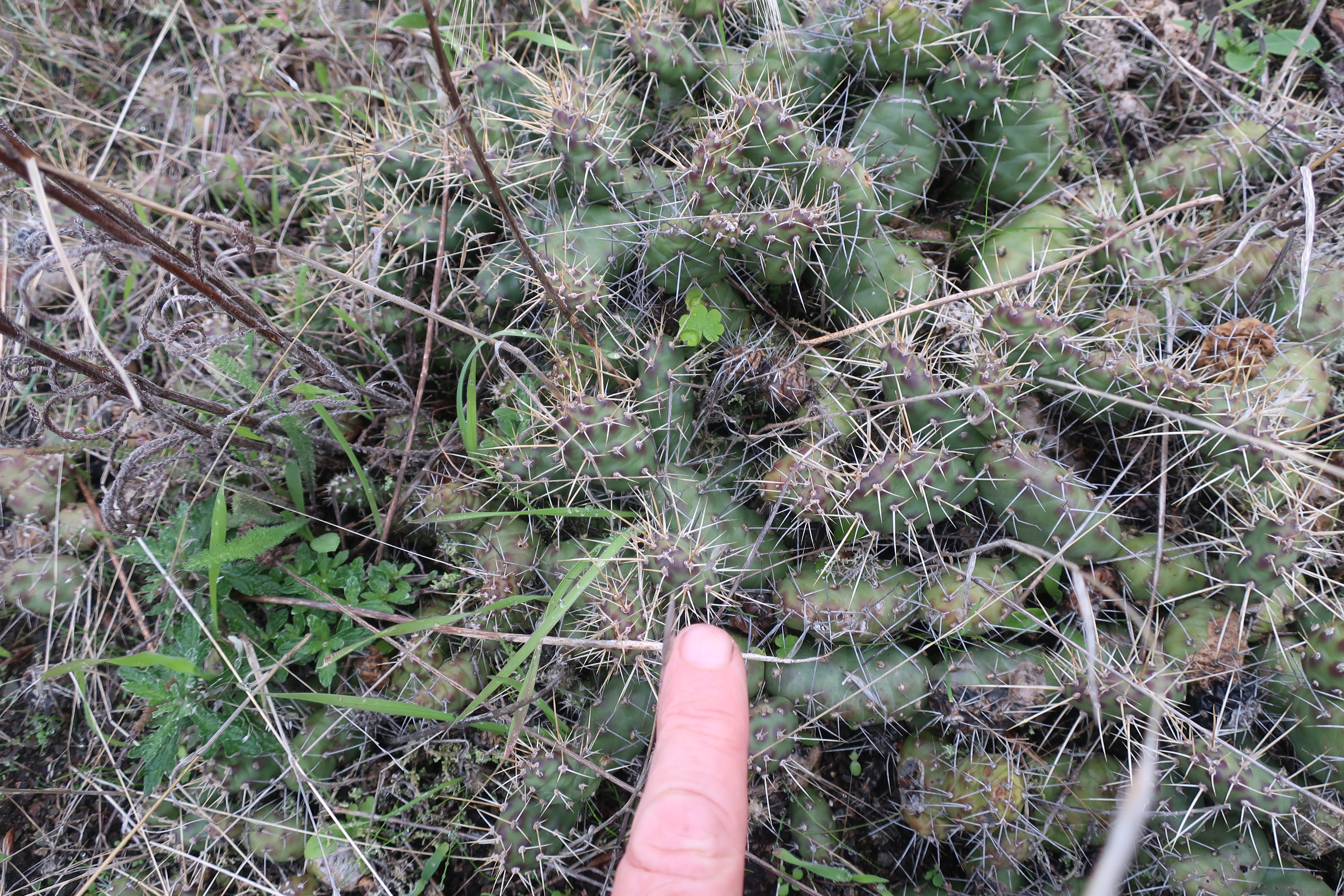
While on a field work venture along the Yakima River in central Washington I came across a patch of what I believe to be Opuntia columbia. I felt fortunate to have seen this patch before I walked into it as I was wearing light shoes. I was once no so fortunate while traversing an area above the Okanogan River.     

Patch of cactus on a high gravel bar above the river

I determined that the patch was broad enough and populated enough that it would be ok to extract a paddle.

Long thorns of Opuntia columbia?

I am nowhere near enough of a botanist to know if this cactus is Opuntia columbia, hence, my tentative identification. That said, I am pretty confident based on my review of Burke HerbariumDesert Northwest provides a nice discussion of the various cacti species in Washington and discusses the botanical debates, but also comes down on this likely being Opuntia columbia

I enjoy seeing cacti in Washington State. Cacti do not have much of a presence in Washington even in the dry areas. This patch was growing on a cobble/gravel bar elevated above the river. The site is high enough that flooding must be very rare as there were some large ponderosa pines on the bar. The cobbles and gravel add to the dryness and have kept competition down just enough to allow the patch to thrive.

Monday, May 29, 2023

Former Giant Western Red Cedars above Lake Cavanaugh

I have had numerous ventures up the north slope of Frailey Mountain south of Lake Cavanaugh in Skagit County. The slopes are steep and streams on the mountain have had a history of debris flows; hence, I have had numerous ventures assessing the geology risks of the area. 

The forest on the lower sloes is predominantly western hemlock. It is one of the easier forest areas to walk through as there is very little understory brush as the hemlocks shade out just about everything. But amongst the hemlocks are big(!) hints of the past.   

Western red cedar stump amongst the western hemlocks 

Large cedar stump and if you look carefully an even bigger one back in the trees

The western hemlock forest is about 80 years old. The Lake Cavanaugh area was nearly devoid of trees by 1940. There is a small remnant patch of old trees on the steepest upper slopes that were either too hard to log or poor quality timber. 

1941 aerial view of area

The big stumps are a reminder that the forests we see today are not static. Given the age of the forests around Lake Cavanaugh area, there has been significant logging in the area the past few years. As noted in a previous post (HERE), the trees that were left are habitat for marbled murrlets and hence some of the forest is protected. And some of the slopes may be precluded from logging due to potential landslides and debris flow hazards. I say 'may' because that can be a geology judgement call clear cut logging has been permitted on active alluvial fan areas.     
 

Sunday, November 14, 2021

Cedar Boughs

 Evaluating a valley in the Olympics earlier this fall I noted these cropped trees. 


The limbing was not for creating views through the forest, but was a partial harvest of the tree boughs for evergreen arrangements and/or wreaths. The trees in this case are western red cedar. And this was an allowed operation by the land owner. Evergreen foliage is a big business on the Olympic Peninsula and southwest Washington, and unfortunately some of that business is illegal harvesting. It is particularly problematic in young tree stands as the removal of branches and even the tips of the trees destroys the tree plantation. The very fact that the trees above were scaled and limbed (by hand) in the manner they were indicates the value of these products.  

Saturday, October 30, 2021

Pine Creek Loses some of its Forest


Malden Post Office before the fire

Attribution of a single wildfire event to global warming is confounded by lots of other factors. The Malden area and Pine Creek valley are located in a climate edge area where pine forests meet grass lands (and now dry land wheat fields) in a mosaic landscape. Pine Valley where Malden is located was already in a fire prone area. Every summer the area becomes dry enough to burn with the grasses and brush being susceptible for a longer period and the trees for a shorter period. Towards the southwest that length of time becomes longer and to the north and east the length of time is shorter. Pine Valley is in a boundary area just moist enough that tree killing fires have been infrequent enough such that the valley has significant forest stands. 

With warmer average temperatures the length of time the area is susceptible to fire is now longer. But other factors can increase fire risk - years of fire suppression and changes to land use also alter the fire risk and how a fire will behave. With lots of roads, fires in Pine Valley could be readily suppressed and put out as long as fire weather conditions were not severe. Land use changes also play a role. Over time the forested areas began to encroach into the Malden town site.

The weather event associated with this fire included very high winds associated with an Arctic cold front that surged across the area from the northeast. The high winds had followed several days of at or near record daily highs in the region. The weather set up and fire risk was predicted several days before it took place (Inland Northwest Weather.blogspot). The same weather event was also associated with a much large fire that burned over 60 miles in the Okanogan Valley as well as the very intense wildfires on the west slopes of the Oregon Cascades.   

Pre and post fire aerial images show that a fair bit of the forests that were in the Pine Creek valley burned during the fire. 

Malden 1954

Malden 2017

Malden 2021

Northeast of Malden 2017

Northeast of Malden 2021

Pine City 2017

Pine City 2021

Wednesday, October 21, 2020

An Unexpected Encounter with Opunntia fragillis

I had a venture on Orcas Island (One of many this year). These trees on the edge of a rocky shoreline slope got a bit of my attention distracting me from the geology.


The evergreen is a Douglas fir. Likely a bit sculpted by wind and occasion salt spay and the rather harsh growing conditions on a bedrock slope with very thin to no soil. The woody brush was what got my attention. 

Oak leaves!

The brush was a group of low growing oaks. As far as I know Quercus garryana is the only native oak in Washington State and I observed numerous oaks in the near vicinity of this patch. The patch of woody brush appeared to be heavily browsed by deer and this can modify the growth habits of the browsed upon trees. Deer can be pretty good bonsai artists.

When I took the picture above I stuck my fingers into the image for scale. I did not see another plant tucked partly under the low oak. It was only after pulling my hand back that I noticed the plant.  

Opunntia fragillis - Brittle prickly pear cactus

This was a first for me on Orcas. I have seen this cactus on Lopez Island and Decatur Island. I had help spotting them on those previous sightings. The picture below shows that the cactus does not stand out.
  

Once I spotted the first patch, or it spotted me, I started looking for other patches and found several. 


The cactus was was often just above the salt spray line. Just enough of a harsh spot to not get out competed by other plants. The Orcas site is on the drier side of the island as the island is situated within the rain shadow of the Olympic Range. 
 
It is a pretty rare plant in western Washington and is limited to the Olympic rain shadow with reports of the cactus on Whidbey Island and northwest Jefferson County on the Olympic Peninsula. This species is also present in the Okanogan area of north central Washington along with a couple of other species of cactus. Its presence in the Okanogan indicates it is highly tolerant of cold weather. 

Perhaps this species pioneered the barren ground after glacial ice retreated and has only hung on in places where other plants have had a harder time. There are theories that these plants on the west side may have been partially nurtured by First Nations peoples. Given the above setting, that seems very possible as it was an appealing site.


Domico, Terry. Brittle Prickly-Pear Cactus (Opuntia fragilis) in the San Juan Islands and Puget Sound Region of Washington State. Douglasia Occasional Papers, Vol. 7, No, 1, pp. 37-50, 1999.