Heading back home recently I watched the main flock of snow geese descending over the Samish Flats.

While making my way through the forest I came face to face with Aegolius acadicus.

The northern saw-whet is a small owl and this one made no effort to make an escape. I had been making a fair bit of noise smashing through a thicket of dense brush before weaving through some branches to meet this owl. Hawks and larger owls prey on them so being down at a low level in the thicker brush is a safer place. Unlike the barred owl that visited the house, this owl seemed fit and alert.

The owl did not take flight when approached. I went about various projects after having been away for an extended time and hoped that the owl might recover from whatever was the cause of its ailment. But I was aware that this owl was under some significant distress. Alas, whatever ailed our visitor resulted in the owl dying the next night.
I find it difficult to spot owls perched in the forest so am uncertain of our very local barred owl population. More often I hear great horned owls and only very occasional will hear a barred. This is the first barred owl I have seen at our house. I have seen great horned owls perched on the same wheel barrow in the picture above.
Barred owls are relatively new arrivals to Washington State. They have expanded their range from eastern North America to across Canada to the Pacific Northwest. The arrival of barred owls has been one of the causes of the decline of spotted owls. Weins and others (2021) evaluated lethal removal of bared owls on spotted owl survival.
Upon approaching a cattle guard a local residence popped up to see what was coming. It stood there facing me. My anthropizing suggesting I was being challenged to proceed as this guard seemed to be standing its ground. I assumed it would be safe to cross and no harm would be befall either if us.


I was alerted to the nearby presence of a northern flicker by the drumming on a metal gutter. The bird then swooped past my head and landed on the edge of a plowed area where he confronted another flicker.


The Skagit Flats and Samish Flats is birding destination. There are plenty of wintering birds that attract the birders, but the short eared owls are particularly cooperative for observation along Bayview-Edison Road near the mouth of the Samish River into Samish Bay. Besides getting to see them in close flight, the owls have taken to perching on the top of the Fish and Wildlife signs within 60 feet or so from the road regardless of the crowd. On a recent mild sunny day the line of people and cars along the road stretched several hundred meters. The short ear owl is not rare, but their habit of hunting during light allows for much easier viewing than the more nocturnal owls.

Antilocapra americana (pronghorn antelope) have been reintroduced to Washington State first by the Yakama Nation in south central Washington and a few years ago by the Colville Confederated Tribes in north central Washington. I finally saw my first Washington State pronghorn last week.

Foster Creek drains the north side of the Waterville Plateau. The creek has three forks that join together a few miles south of Bridgeport before discharging to the Columbia River just below Chief Joseph Dam and just east of Bridgeport. State Highway 17 follows the East Fork up to the glacier scoured upper northern part of the plateau. As the creek descends down for the glacial scoured upper plateau it descends through an area of glacial lake sediments deposited in the valley from the ice dammed Columbia River Martin (2001). The fine silts are subject to rapid erosion and over a stretch of the valley has formed a badland area (mini-badland-southeast-of-bridgeport).
When the creek reaches the glacial lake sediments, the creek is subject to forming deeply incised arroyos. Blanton (2004) discusses the complexity of arroyo development and riparian management along the West Fork of Foster Creek.
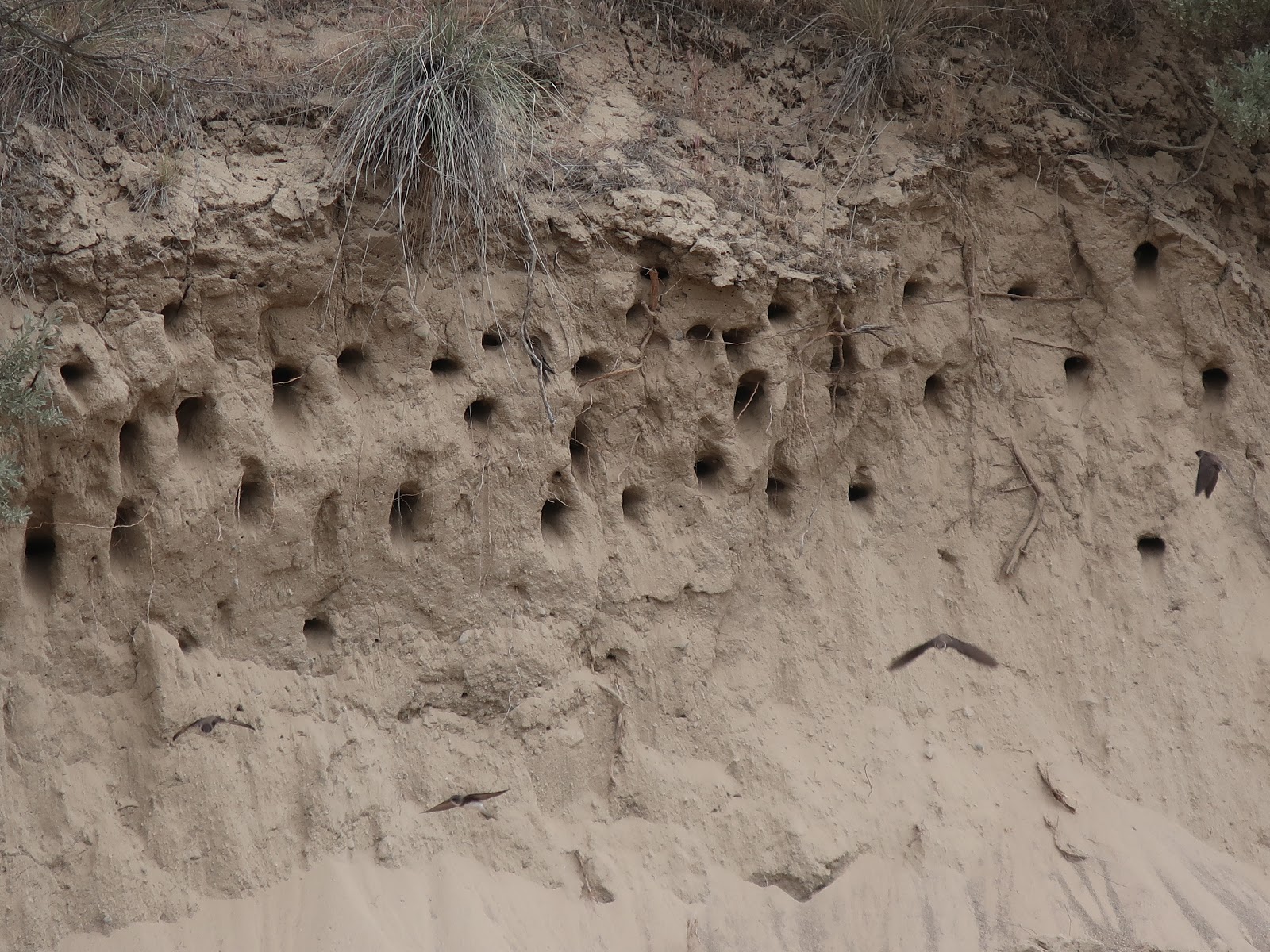
One of the issues of arroyo development is the deeply incised stream lowers the water table along the creek except in the bottom of the arroyo. That reduces the width of the riparian zone and the beneficial habitat (note that the arroyo banks have beneficial habitats as well such as burrows for cliff swallows). The lower water table and narrowed stream channel also impacts down stream sections of the creek. More intense peak flows during storm events or snow melts can be one result or the reverse: a loss of storage in the areas of the lowered water table may mean lower flows in the dry periods.
An approach to back up the water is to copy something that has been missing in the watershed. Jay guided me to a project on Foster Creek that is being used throughout the west -- a beaver dam analog.

On Monday I headed to central Washington via the Highway 20 across the North Cascades over Rainy Pass and Washington Pass. A cold rain was falling in the late afternoon as I crossed the passes. The sky cleared by the time I reached the Columbia River at Pateros so I opted for camping at a favorite site that will remain secret. When I got into my sleeping bag it was 63 F -- a bit warm for sleeping, but by morning it was 36 as the cold air caught up to me.
It was hard to tell as the mountains still have lingering late snow, but it looked like there was fresh snow on the North Cascades in the morning.

I had to head back Tuesday and noted the fresh snow on the trees and peaks on my return.


The first time I tried geoduck was via a gift from shellfish business I did some geology work for. I have since dug for them a few times during very low tides. They are a fun prize to pull up out of the sand. One big goeduck is more than enough for a meal. But those big geoducks take many years to grow. As their value has increased management of the resource has become more important.