Evaluating a valley in the Olympics earlier this fall I noted these cropped trees.
Sunday, November 14, 2021
Cedar Boughs
Saturday, November 13, 2021
Chicken Eggs
Traveling to a field work site I came across one of the larger egg producers in Washington State. The packaging for the eggs notes that the chickens at this farm are free ranging. Agricultural friends have told me that the egg labeling is accurate. I got to see what a large scale free range chicken operation looks like. Thousands of chickens meandering through open grass fields.
Thursday, June 17, 2021
Plane Notes: A Few Infrastructure Observations
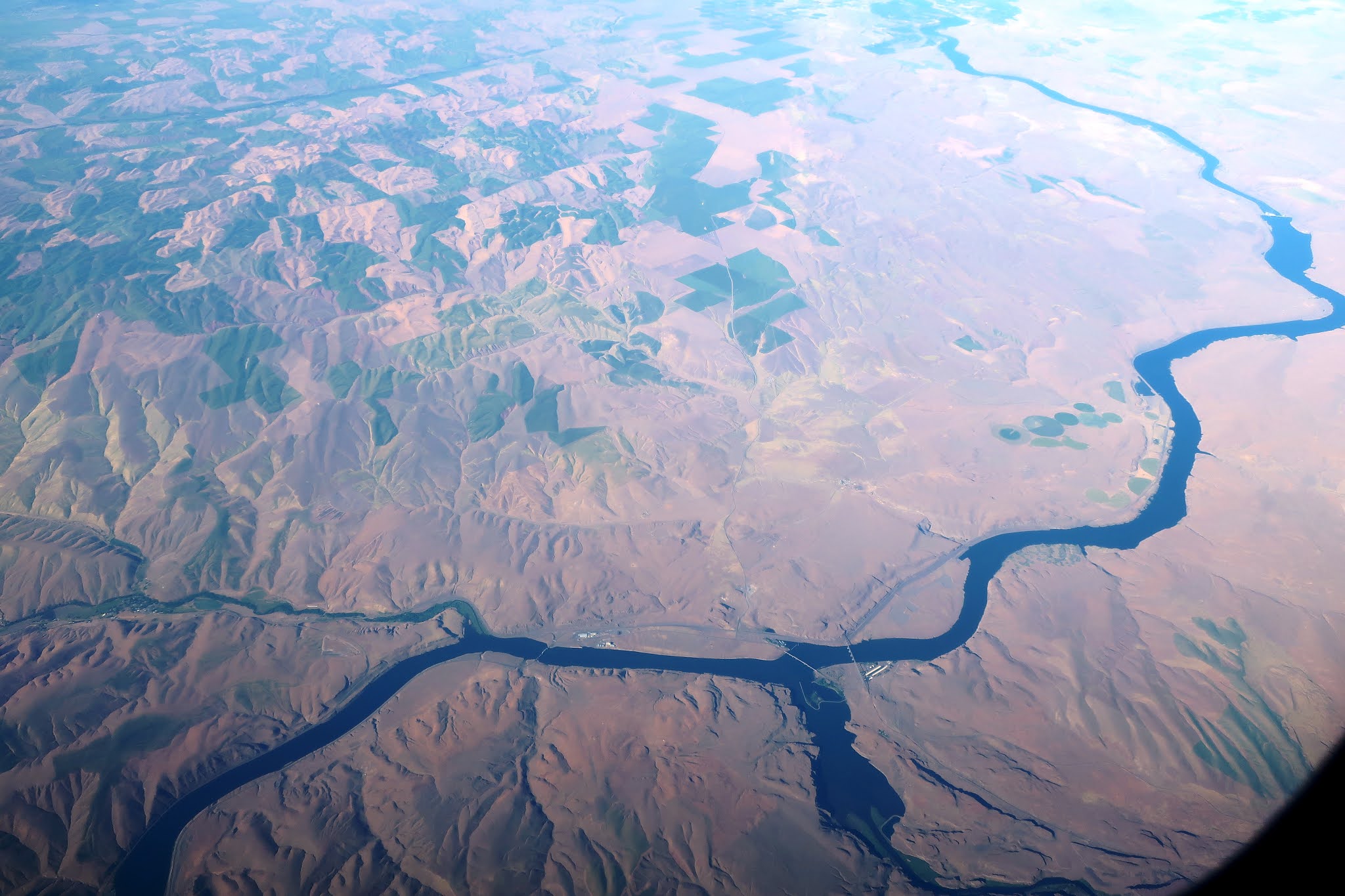
Aerial views are part of my routine 'tool box' as a geologist. I use aerial photographs on a nearly daily basis for multiple reasons. Other aerial imagery is utilized as well - lidar, infrared and sometimes radar imagery. I enjoy this type of work and a there is a sense of discovery when viewing aerials.
I had previously seen the below feature when reviewing historic aerials for a project, and hence, when I got a view of it while flying out of Seattle knew exactly what it was.
Thursday, May 27, 2021
Blowing Dust in Skagit and Douglas Counties
Last week while on the Waterville Plateau in central Washington I observed a bit of a dust storm to the east in the early morning.
The dust blow was from an area that burned last September that is also underlain by glacial lake sediments. Glacial ice from the Okanogan ice lobe blocked the Columbia River forming a large ice margin lake. The lake sediments are very fine grained and readily will erode via both water and wind from areas of disturbed ground.
More surprising was the dust storm mid day today on the Skagit River delta.
I sent a few pictures to Cliff Mass and he has a write up on today's wind event: dust-storms-on-both-sides-of-cascades. Cliff included some pictures from the Tri-City area, a place where I experienced my share of dust storms.
Josh Ritter starts a song that is apt for dust storms and farming: "Dirt roads and dryland farming might be the death of me. But I can't leave this world behind" Josh Ritter - Lawrence, Kansas. I will just note that all the rain in Skagit winters precludes dirt roads in the farm land.
Saturday, June 8, 2019
Canola in Central Washington
Connolly, McCracken and Painter (2016) describe a cost spread sheet developed for farmers considering planting canola. There has been an uptick in canola in Washington in part due to a canola oil plant built in Warden in 2013. Viterra recently gained full ownership of that plant (Press Release to WSU). Improvements to infrastructure and technical support may lead to expansion of canola in Washington.
The term canola is derived from combining "Canada" with "ola". Canola is a product of breeding out the undesirable part of rapeseed and was developed on the plains of Canada. Viterra is a Canadian Company.
Changes in farming can be global, and a big market for canola oil is China. The US-China trade struggles may impact these brilliant yellow fields. China has its own canola agriculture and has had trade disputes regarding canola imports to China from Canada that recently popped up again likely associated with the Huawei case.
Saturday, June 1, 2019
Glacier Peak Tephra on the Waterville Plateau
The small grains in the soil are tiny pieces of volcanic tephra. Given the central Washington location and the distribution of the grains Jay described, the source of the tephra is likely from Glacier Peak (Porter, 1978 and Kuehn and others, 2009).
This seeming small feature is a big deal to the local agricultural productivity. The tephra fragments allow the soil to hold a lot more moisture and thus adds significantly to the productivity of the fields where the volcanic material is present. The various tephra deposits are an important dating tool and thus tephra deposits are of great interest to more than geologists. Glacier Peak had a particularly violent eruptive period during and after the last glacial period. Mount Saint Helens and Mount Mazama also deposit tephra over a large areas. The three volcanoes have left dating markers over wide swaths of teh northwest.
Friday, April 19, 2019
Snow Geese on Samish and Skagit Flats Have Not Left Yet
Apparently the leave date varies for these birds (Stevick, 2017). A later leave date may present problems as the flock may do a heavy graze on fields that have been planted. In this case the field has not yet been planted and the field that the flock was leaving is a Fish and Wildlife holding.
Friday, March 1, 2019
Mayview Tram, Snake River, ca. 1935
Mark alerted to a video of the Mayview Tramway in action. There is write up on the tram at historylink.
Sunday, July 8, 2018
Trade War Notes
Mexico has been especially strategic and that nations's retaliation will hit Washington fruit hard as well as potatoes. The Canadian strategy is to avoid supply chain issues for Canada.
I am not convinced about the Trump administration strategy, particularly with regards to Canada, Mexico and the EU. And I suspect that China situation is not well understood and will lead to long term harm.
Krugman knows a bit about trade and suggests that Trump will be well remembered for his statement that "trade wars are good and easy to win": Krugman: how-to-lose-a-trade-war
It appears the European thinkers will be strategic as well voxeu.org/new-cold-trade-war.
For Washington State - exports will remain important. It will be hard to consume all those apples.
Saturday, March 31, 2018
Friday, August 4, 2017
Bauermeister Wheat
At least the road name warns about Bauermeisters. Bauermeister Road leads to Bauermeister Farm. This dry land wheat farm is southeast of Connell and I liken these dry land wheat farmsteads as small islands of trees in a sea of dry land wheat and scrub steppe. The nearest neighbor to the Bauermeister farmstead is nearly one mile away.
Dale and Dan Bauermeister were active participants in trials of wheat strains put on by Washington State University. One hard red wheat variety tested on their farm was named for the farm (Red/Bauermeister.pdf).
That variety along with other wheat varieties is changing how wheat is being grown and turned into food (https://www.nytimes.com/2015/11/01/magazine/bread-is-broken). Wheat fields in Skagit County are growing Bauermeister wheat and the resulting flour and bread is bringing about a change in bread (new-wave-wheat). New local wheat varietals and baking can be likened to the early days of craft local beers.
From the New York Times article "A couple did not have much flavor or structure, but one of them in particular, Bauermeister, knocked my socks off."
Thursday, November 17, 2016
Samish Island: No Ferry Needed
The island is connected to the mainland via tidal mash and tidal flats where dikes were built to create farm land during early American settlement. The initial survey map shows a narrow continuous water connection across the area shown in the picture above.
It should be noted that the water covered areas of the map, Samish Bay on the far right, Alice Bay on right and Padilla Bay on the left all become mud flats during low tides. Very high tides would inundate the marsh land if not for the dikes that keep the high tide water out.
In the early days of American settlement, building dikes to farm areas of delta land was a quick way to develop farm land as little tree and brush clearing was needed. The down side is maintaining drainage. The lower areas become difficult to maintain and over time some of these areas have been abandoned as farm land, at least in part due to drainage problems or periodic inundation with sea water.
River flooding into the delta creates a situation where the dikes used to keep the sea water out end up holding the flood waters in and Samish Island becomes an island once again.
Monday, March 7, 2016
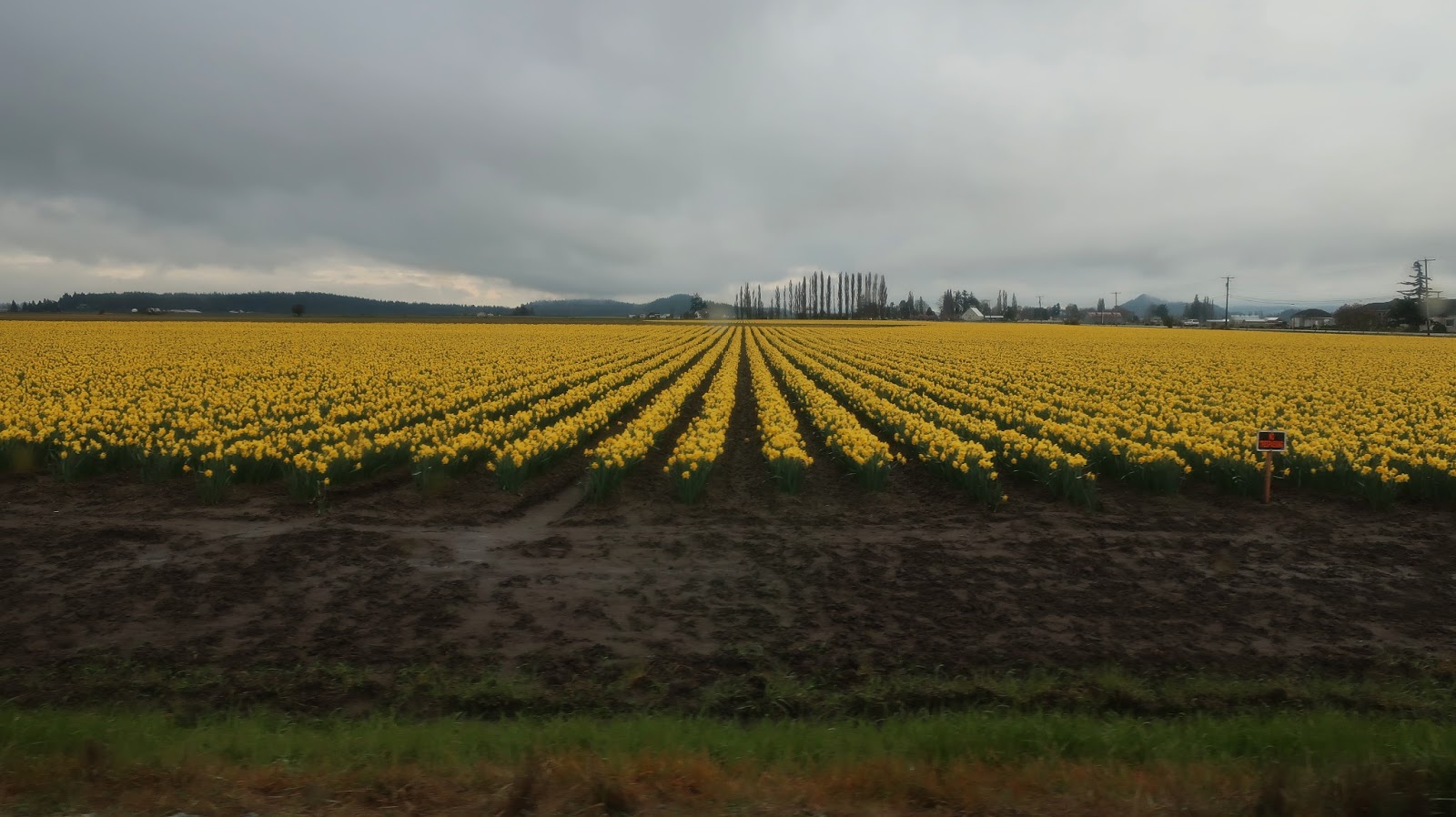
Daffodils on the Skagit Flat
But after excavation work was done I caught the daffodil blooms on the Skagit Flats west of Mount Vernon.
A few tourists or locals had stopped. Turns out two of my neighbors were visiting this field as well. The hills in the distance are Mt Erie on Fidalgo Island and high points of various San Juan Islands including Mount Constitution.
Another field with the Northwest Cascades in the distance.
The daffodils are a bit early this year as it has been a very mild winter. Apparently saturated fields from heavy rain has not slowed the bloom time down.
The Daffodils do not bring out the tourists as much as the later blooming tulips will. A sunny weekend day on this same road would require some patience during the tulip bloom.
Monday, December 7, 2015
Dry Land Wheat Harvest and Towns
Historic wheat harvest pictures tell more than simply the old ways. A little thought also tells a demographic story which is reflected in the dry land wheat towns of eastern Washington.
The above picture shows that harvesting and shipping wheat required people. The equipment would require people. the horses would require people and moving bags of wheat would require multiple handing and storage. Some of this effort would have been taken up by traveling crews. But many would be local. The number of employees or farmers required today is tiny compared to the situation 100 years ago. And that in part explains the appearance of numerous eastern Washington dryland wheat communities.
The change was not immediate. And it has been ongoing. Even the past few decades, long after horse and ox were had no longer been in use for many years the number of workers needed has continued to decline. Farm equipment has gotten better and more reliable. The same can be said for the cars we drive and the way food and goods are distributed. A long list of reasons some of the small towns have faded.
A couple of years ago I had some field time over in the dryland wheat and learned just how much some towns had shrunk. Lesson learned about the lack of places to have an early breakfast.
Monday, November 30, 2015
Winter Alfalfa Irrigation and Stateline Wind Farm
The ice age flood silts will hold a lot of water and alfalfa will grow as soon as the weather begins to warm. Hence, irrigation is a year round project to build up and maintain soil moisture in this otherwise very dry area on the southern half of the valley.
A new type of "farming" can be seen on the ridge line south of the valley. The State Line Wind Farm is one of the largest in the region with wind turbines lining the crest of the Horse Heaven Hills along the Washington-Oregon boundary. These turbines catch the wind rising up and over the Horse Heaven Hills from the Columbia River gorge to the west.
Thursday, October 22, 2015
Apple Season, Migrant Workers and Wenatchee Wlamart
Monday, October 12, 2015
Dust Blow
Overall though conditions were not bad with the dust blow up in this area being limited to a bit of a low area that perhaps had had a bit less rain and was a bit warmer. Hence, a rather rare event of seeing dust blowing up into the sky but with overall clear conditions. It also helped that we were upwind of the dust - much better than being down wind. Dust storms do happen in eastern Washington, but the frequency has become less with improved farming practices.
This area of dry land wheat farming is winter wheat only. The wheat begins growth ideally in September and is well established by the time cold weather arrives and then finishes growth in the spring with harvest in the summer. After harvest the fields harvested are left fallow for a year to allow moisture to build back up. At wetter areas to the north and east of this site plantings may take place every year and may be rotated with nitrogen fixing crops.