Tuesday, March 19, 2019

Counting Pebbles in the Olympia-Age Sediment

A recent shallow landslide on a steep Whidey Island bluff had stripped off all the vegetation and top soil from the slope providing a good exposure of the underlying geology units.  


Most of the bluff at this slide site is underlain by non glacial sediments that were deposited prior to the last glacial period. The non glacial sediments consist of alluvial sediments with layers of silt, sand and gravel as well as peat - the peat being a strong indicator of a non glacial environment. The non glacial sediments are likely Olympia-age (60,000 years to 20,000 years). The sediments are very compact and hard due to having been compressed by approximately 4,000 feet of ice during the last glacial period. As such the sediments can hold a very steep slope for long periods of time. The hard freeze and then rapid snow melt in February played a role in being final trigger for this slide. 

Near the base of the slope I observed a sand and gravel layer. Even though this unit has been compacted by the over riding glacial ice as well as an unknown thickness of sediment before the ice arrival, the unit lacks silt and clay and thus I was able to easily collect some sand and gravel. 


The most dominant pebbles in the gravel were irregular lumps of quartzite.
  

The conglomerate in the base of the Chuckanut Formation some 20 miles northeast of this site is full of similar pebbles. The quartzite pebbles in the base of the Chuckanut are derived from weathered Darrington Phyllite. The rivers that deposited the Chuckanut eroded weathered phyllite and concentrated the hard resistant quatzite into gravel deposits which became the basal conglomerate of the Chuckanut Formation approximately 54 million years ago.

The pebbles in the Olympia-age sediments can be viewed as geologic history repeating itself. A river system eroded the Darrington Phyllite and carried these hard resistant pebbles westward. There would have been no Skagit Bay between what is now Whidbey Island and the Skagit River. The Skagit River likely extended well to the west before the last glacial period removed much of the large alluvial plain that would have extended out from the Cascades to the west.     

Friday, March 15, 2019

Sea Otter Off the Quimper Peninsula

The northern shore of the Quimper Peninsula consists of steep bluffs rising sharply above the Strait of Juan de Fuca. Approaching the edge of the bluffs along this shore reach is always a bit of a thrill and there is always the reward of a great view. 

Protection Island

North shore of Miller Peninsula with Olympic Mountains in distance
     
Steep drop to the beach below

If the above picture is blown up large you might be able to spot the two seals. Zooming in with the camera better captures our bird's eye view of the seals patrolling the coast.   


Later in the day while on the beach I noted an otter as well as a seal.

Otter is near and seal in the distance

This otter exhibited different behavior than the typical otters I am accustomed to. Typically river otters will lift their heads up high and stare at me either out of curiosity or making sure I am not trouble. This otter appeared to pay no attention to us. It also seemed a bit large for a river otter. The otter then did something river otters do not do. It floated on its back.


The otter was just far enough away that it was hard to get a definitive look, but I am fairly confident this was a sea otter. There is a fairly stable population on the outer coast after reintroduction and the slow recovery of the species after being hunted to near extinction for their thick fur.

Sato (2018) (wdfw.wa.gov/publications) notes that the occasional sightings of sea otters are reported in the Strait of Juan de Fuca and even rare sightings within Puget Sound. This is the first time I have seen one. This particular shore reach has a rich platform below the water with bull kelp. The underlying geology is a factor. The platform is underlain by boulder-rich Possession glacial till (more on that in a future post) that provides a rocky substrate. 

Friday, March 1, 2019

Mayview Tram, Snake River, ca. 1935

Mark had a request to use a picture I posted on the remains of the Mayview Tramway, a wheat tram above the Snake River (Getting the Wheat to the River). He

Mark alerted to a video of the Mayview Tramway in action. There is  write up on the tram at historylink.

Sunday, February 24, 2019

Bluff Erosion and Abandoned Road Above East Sound, Orcas Island

East Sound is an embayment on the east side of Orcas Island. The sound is very much like a fjord. At the head of the sound are two bays separated by Madrona Point. The western bay, Fishing Bay, has a rocky shore and the town of Eastsound (note the words are combined for the town name) is located above the bay. The eastern bay is Ship Bay with a sand and gravel beach and, to the southeast, a steep bluff non bedrock bluff. Wind generated waves coming up the sound from the south erode the bluff. A road formerly was located along the bluff; however, shoreline erosion and bluff failures led to moving the road by the 1960s.     

Pavement in not forever


Missing road section and view down the fjord-like East Sound

1941 aerial (USGS) of road along the bluff


Erosion is continuing


Wednesday, February 20, 2019

A Large Flock of Snow Geese

Driving across the Skagit Flats in winter I frequently encounter snow geese. I have posted about snow geese before: white-russians-in-northwest-washington. On my way to Whidbey Island late this morning I encountered the largest snow geese flock I have seen south of Bay View. They had been out on the tide flats during the snow, but grass fields are their preferred wintering ground.  


Wednesday, February 13, 2019

A Tree to Follow

Hollis at plantsandrocks.blogspot has been seeking a tree to follow. I like the idea. I have had trees I would pay attention to through a year or two or sometimes longer.

During a different era I would stop to admire a struggling elm on the side of a ravine in eastern Washington. The tree was the highest up the slope growing along a good 100 feet above the trees growing in the ravine bottom where water was more plentiful.

There was another elm growing adjacent to a very old hand dug well in a lonely valley in the Horse Heaven Hills south of Kennewick. It was the only tree for miles. For several years it contained a great horned owl nest. I would purposely plan long runs to visit the tree - it was a 12 mile round trip.

A lone maple growing on the south edge of High Street Park in Bellingham is still a favorite. It's fall show was always spectacular. It is not a native maple and had survived its previous use as a landscape tree for the elementary school that had once occupied the site.

So when Hollis had a post about finding a tree to follow for a year I thought I should find one that I can easily visit once a month. Yesterday I found one nearby as I was returning from my ventures.


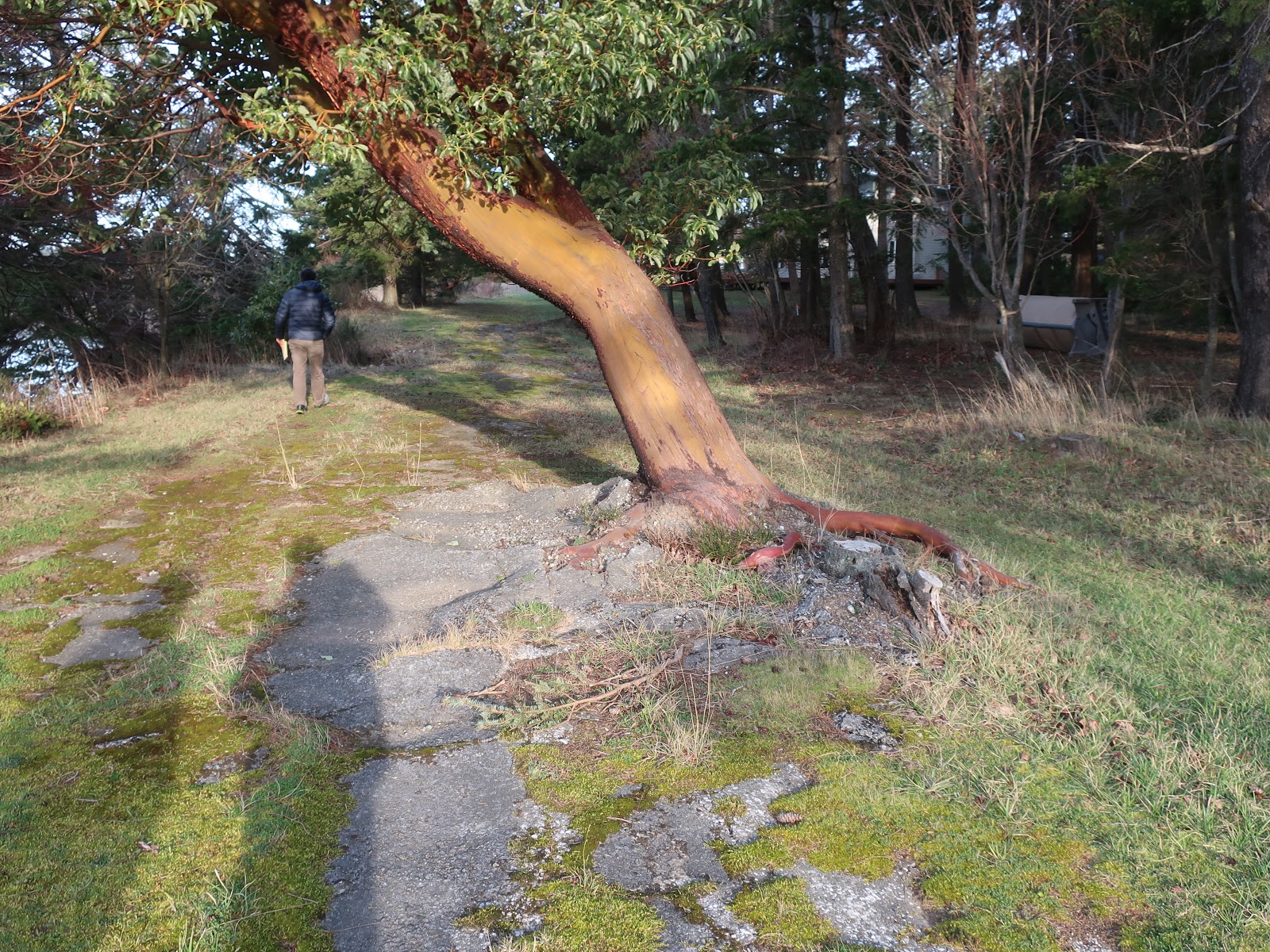
I do not believe this tree is a native, but clearly it is well established and appears to be more than tolerating the environment upon which it was planted.


Tuesday, February 12, 2019

Snow Day on Samish

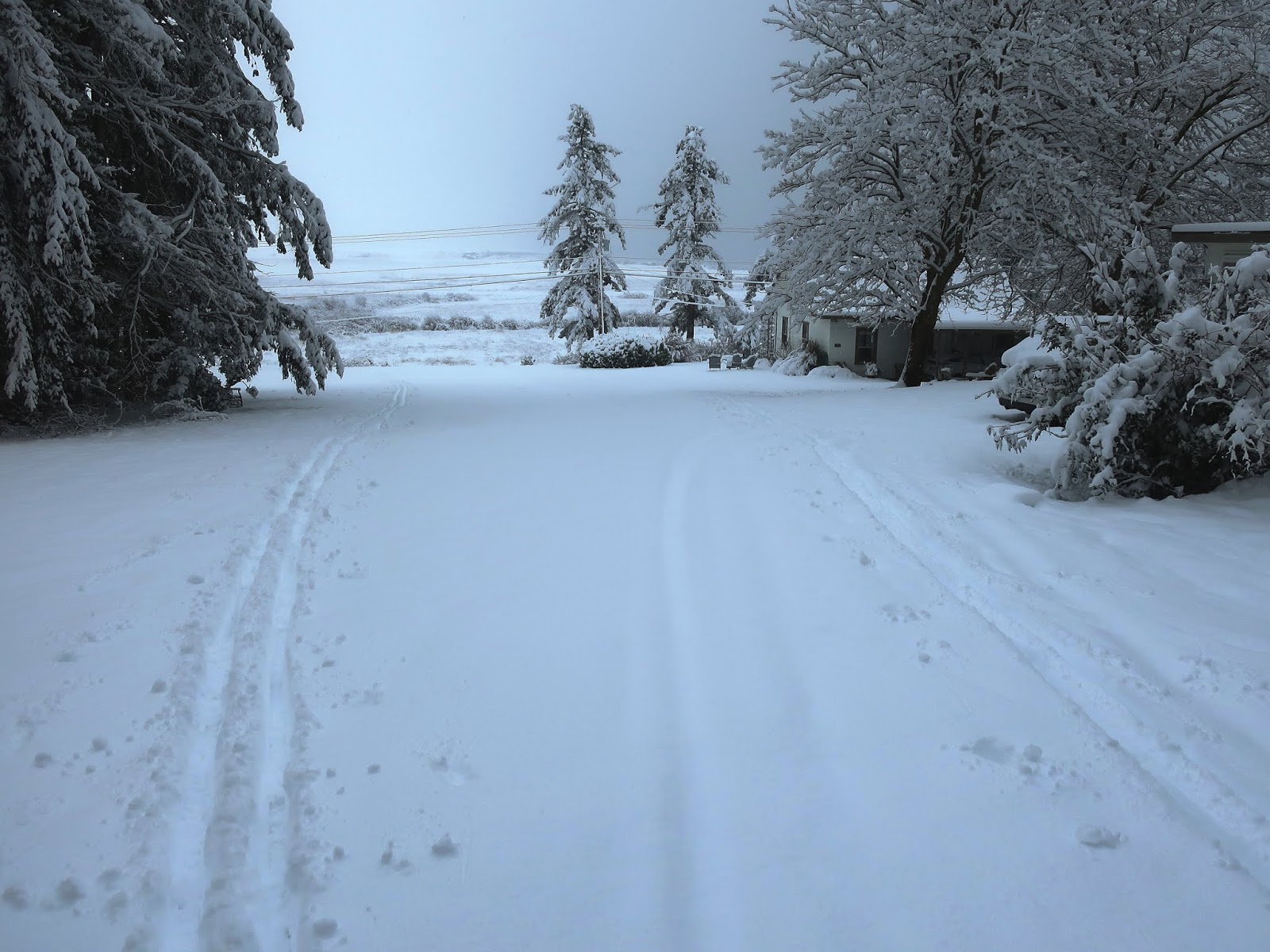
The variable nature of snow events in western Washington is fascinating. I enjoyed our first big snow at our new home on Samish Island. Roughly a foot fell over night.

The snow was sticky and gave the "plantation" part of the forest a good coating 

I made about a dozen ski runs on the very mild slope

The snow had coated the calm tidal areas of Alice Bay and Samish Bay and rafts of slush were floating out with the tide at the east end of the island


Barge with tractor is part of the shell fish farming operation in Samish Bay

Northeast shore

Slush on shallow tide water

Bald eagles returning from their duck hunting

Young eagles on a well designed perch 

Tidal lake covered with slush

This snow event was a tree trimming event. Lots of loud snaps as limbs snapped off in the forest