Tuesday, November 6, 2012

Policy and Rudeness

I have generally kept politics out of this blog this election cycle with the exception of Washington State Initiative 502. Plenty enough politics to read particularly about Ohio.

But past election time we head back to governance. Simon Wren-Lewis put up a post where he attempts to work his way through when it is OK to be rude on policy matters mainlymacro.blogspot.sg/being-rude-about-austerity. Perhaps some lessons here in regards to how to move policy one way or another.

A couple of other economists have picked up on this. For a fair number of economists the past few years have been difficult. And perhaps because of the economists I tend to read, it has been particularly difficult - European leaders going in the absolute opposite direction as to what macro economists thought they should; hence, a bit of rudeness from Mr. Wren-Lewis towards United Kingdom leadership. In the U.S. Paul Krugman has been very critical of the US GOP leaders, but he also made it very clear back in early 2009 that Obama was aiming too low on economic recovery.

I have at times tried to assess my own civility as a policy maker (elected and appointed), as a consultant working for project proponents and opponents, and as an activist. As general rule, I think it is a bad idea to turn to rudeness at a tactic as the message often gets lost, but I cannot say that being blunt to the point of rudeness is not without merit.

Its a hard thing to judge. There are times when it is almost impossible not to be rude and I cannot say in a policy struggle I have never been rude. I once called an idea put forward by an unnamed opponent "ignorant". I still believe it to be true, but I also can't say it accomplished much other than offend.

I had an experience with a high level state official where I was a bit astonished with the lack of understanding of a particular issue. My understanding of the issue was in such sharp contrast that it made things a bit awkward. About a week later I had a meeting with this official and I was a bit nervous. But in a class act the first topic was to inform me that I had been right and it was appreciated that I had spoken up. I would hope I would do the same.

Anyway, stuff to think about as we move past this latest election cycle. 

Friday, November 2, 2012

Typhoon and (Sandy)

I'll be seeing Typhoon at The Shakedown at 1212 North State Street in Bellingham tonight.

Carey Ross did a nice write up here:
http://www.cascadiaweekly.com/entertainment/a_cacophony_of_joyful_noise

An example of Typhoon and lest we forget the Jersey Shore the Boss and the E Street Band performing Asbury Park 4th of July (Sandy) back in 1975.


Thursday, November 1, 2012

Sandy's Global Warming Lesson

I heard the first news stories today regarding a linkage of Sandy and global warming. And I suspect there may be some internal debate within climate research as to the whether the odds of this type of storm has been increased because of Arctic warming.

But putting that aside I do think there is a valuable global warming lesson with Sandy. That lesson is that atmospheric models are getting very good. Global warming linkage or no global warming linkage, the atmospheric models that have been developed and run on big computers did an amazing job with this storm. Days in advance the weather models in common usage were predicting this storm with remarkable accuracy.

This was not simply spotting a big storm and saying there is a big storm heading to the coast of New Jersey and Delaware. No this was taking thousands of data points from thousands of miles apart and calculating what would happen. The models came up with a solution that was far from the ordinary. Solutions that would cause one to ask, Could that be right? Indeed the solution, as outrageous as it seemed, was dead on right.

It truly is a good thing that emergency managers and high level politicians took the model solutions seriously and acted well ahead of the storm arrival. Paying heed to the model solutions saved many lives. There can be debate about Sandy and global warming, but the bigger lesson from Sandy is the complex atmospheric modeling efforts are predictive even when solutions outside living memory are predicted. Perhaps Sandy demonstrates that we should pay heed to the climate solutions that climate models are predicting.     

Monday, October 29, 2012

Forest Practices Unhappiness

Last winter a paper  (Abstract Wittaker and McShane (2012)) suggested that landslide screening tools developed by the DNR were reasonably good at predicting potential slope problems. We also suggested that these tools could be better utilized than they have been. We also made a real effort to recognize that the screening tools available could be and will likely be improved (this is particularly true as LiDAR becomes more utilized). I've encountered some folks that were not happy with that paper. But then I have encountered a few folks that have been unhappy about this:

Slope failures on forest land in southwest Washington
Red dots are my own inventory of slide sites

The paper has given me some perspective on the difficulty of changing policy so messes like the one pictured above are better understood and managed. It has also driven home how sensitive agencies can allow themselves to get.

Sunday, October 28, 2012

First Coal Terminal Scoping Metting: We Are All Wonks Now

I attended the EIS (environmental impact statement) scoping meeting in Bellingham. This was the first meeting since the proposed Cherry Point Coal Terminal submitted final applications. This issue is a huge deal locally in Whatcom County but has global significance as well. The proposal is to build a very large coal export terminal to export United States coal from the Powder River Basin (geologic basin) to China. 

This issue has been and will likely continue to be well covered by media locally and nationally so I have generally left it alone of late on Reading the Washington Landscape unless I have something else to add.

And I should add that I attended as a volunteer to help with organization (follow orders) and to comment on the scope of the EIS regarding train issues and CO2.

One minor drama missed in the media coverage was the booth issue. Opponents of the terminal had been told no rallies, microphones or booths were to be set up on school grounds. Hence, when terminal applicant employees set up a booth some minor drama followed. 

GPT (Gateway Pacific Terminal) set up tents and info booths at 6:30 am

School District informs GP that booths and tents are not allowed

Police follow up saying the tents have to go.

This was really a tough event for these employees. GPT had been running full page adds in the daily paper and radio adds all week, they got up early in the dark to set up booths, and almost no one came in support of the terminal. 

The other pre meeting entertainment was the sign war. Terminal opponents had lined the street with signs. This was followed by a counter sign installation.

Coal terminal opposition lined street with signs

Counter sign installation being documented by AP reporter (and me)

This meeting was heavily attended. An Ecology staff person with a counter counted 1,800 people. Not sure if records are kept regarding EIS scoping meeting, but I would not be surprised if it was a record of some sort. 

Wayne (Whatcom County) directs traffic after lower lot is full

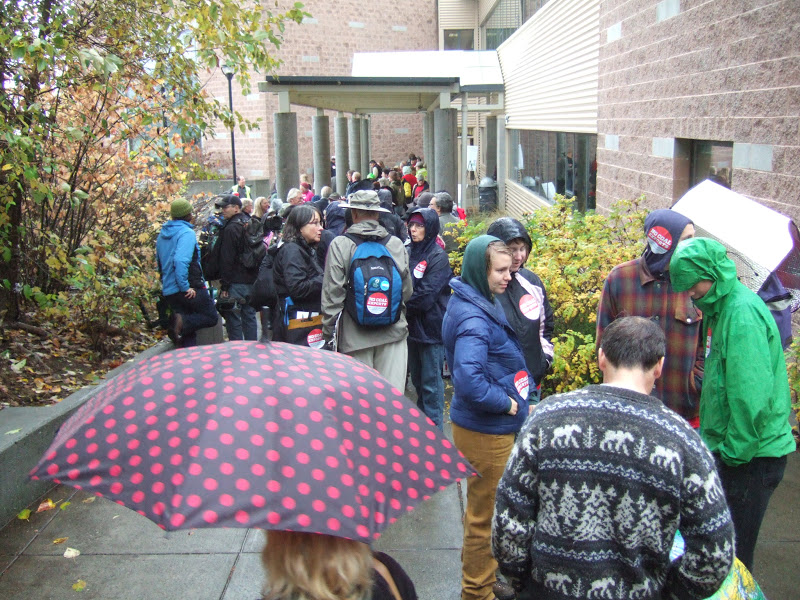
Lined up for the meeting

Waiting to get in

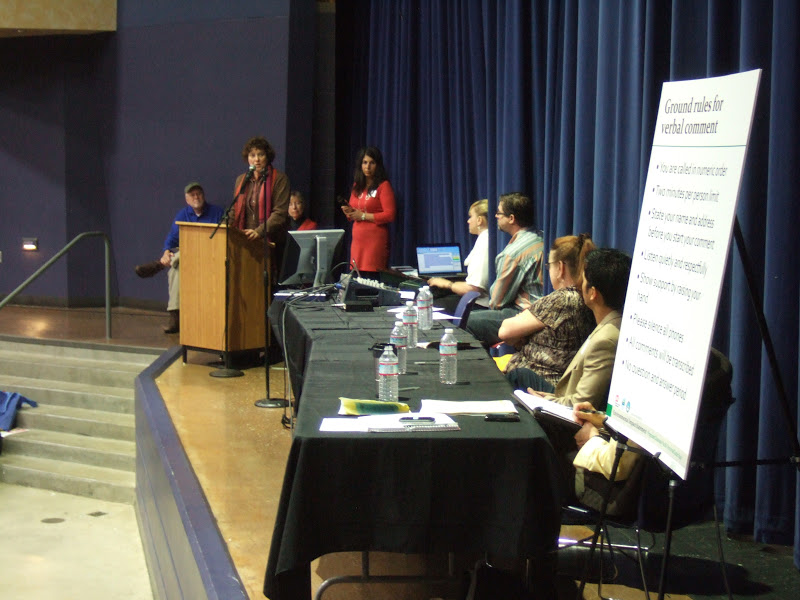
But EIS scoping meetings are not just about numbers (although that does matter). The Scope of the EIS is about substance. And this part of the meeting was truly impressive. I have been through scoping meetings as a citizen, a consultant and as a panelist determining the EIS scope. I have never seen anything as close to the level of of sophistication of EIS scope comments as I witnessed yesterday. The people commenting were not paid experts or paid staff. These are just regular folks that have studied the issues that they believe need to be evaluated in the EIS. Whatcom County has become a bunch of policy wonks.I spoke with a number of people I know that have been through these types of processes and all were equally impressed. We came away proud of our community.

I can not possibly touch on all the comments, but will provide three highlights.

The first speaker

The first speaker spoke about PM 10 and PM 2.5 and health risks associated with diesel emissions. PM? particle emissions and the number refers to particle size. There was a comment much later that brought this issue into more than an abstract concept. With very long trains hauling coal shorter trains with engines running must park at sidings at various locations along the rail route and in some cases this will be right next to where people live. The particulate emissions then turn into an episodic point source for those on nearby properties.

Agency folks listening to comments

Watching the agency folks listening brought back memories. This group appeared attentive and have a long job ahead of them. This was the first scoping meeting. There are nine more at various locations around the State of Washington.

Duane impressed to crowd but also made a very valid point regarding the Scope of the EIS

Duane pointed that the proposal to export huge volumes of coal is counter to the problem that scientific consensus has reached on CO2 and global warming and that this issue must be addressed in the EIS. It is this issue that has turned this terminal proposal into more than a local issue, but a global one.  
  
Lummi witness

A pregnant woman almost always makes for a compelling witness - they are symbolic of the future. This woman though really woke people up. She started out speaking for about 15 seconds in a language other than English. She was spoke Lummi. Her being a "Lummi witness" is a distinction that is critical to how the Lummi People view this project. 

Early on I had noted the PR campaign that had been launched by the terminal proponents
coal-terminal-preemptive-strike. The one thing I conclude definitively regarding the coal terminal proposal is that the PR campaign has not worked. Yes, the usual "build anything" crowd will support this project, but a PR campaign was not needed for that group. But the reality is in the comment session I attended comments that could be categorized as opposed or very concerned was 48-1. 

Friday, October 26, 2012

A Little Political Bias

Our recent experiences can bias our interpretations. I had the feeling I was misunderstanding this painting in Santa Marina Trastavere, a church in Rome.

 
A painting with a very large number of men clearly having an important meeting. And the women outside the meeting doing other stuff. My bias from recent events in the United States caused me to think that perhaps this was an early feminist statement about men making decisions about women. Somehow a way ahead of its time painting commenting on how men were excluding women. Alas my understanding of early 16th Century allegory imagery is a bit lacking. The painting is an image of the Council of Trent and the central female figure is an image of the Roman Catholic Church along with lots of other female figures representing other topics and places.

My bias about the image was perhaps seeded by Congressional Hearings earlier this year:


And even the sillier and then nastier stuff that followed.


I have to wonder what the all male Council of Trent would think of the dispenser next to the informational sign in the square in front of the church?

 
And for that matter what some of our own leades are thinking?


Tuesday, October 23, 2012

Seismic Trial: Lessons from L'Aquila

The court case regarding six seismologists and a public safety official regarding a deadly quake in L'Aquila, Italy has been rendered with the seismologists and the public official guilty of manslaughter and sentenced to prison http://www.bbc.co.uk/news/world-europe-20025626.

Earlier stories regarding this case bring some perspective: http://news.bbc.co.uk/2/hi/programmes/newsnight/9593123.stm

http://www.nature.com/news/

As someone that routinely assesses geologic risk as part of my work I have found the circumstances of the quake and the case itself of particular interest. In following this story, it is clear that mistakes were made regarding how risk was communicated to the public; however, parsing out just what went wrong and Does bad communication warrant a criminal conviction? is a bit complicated and the above articles at least try to shed light on the case and issues.

If there can be any conclusions it is 1) earthquake prediction is very sketchy at the present time and 2) communicating risks from earthquakes needs to be done very carefully - providing assurances that all is safe is a really bad idea - particularly in a city with buildings that were well known not to be safe. I am sure that the convictions will be appealed and the end results of this trial may turn out very differently. The Italian judicial system is a bit different than our own. This trial was in the very city where the quake took place and decided by a magistrate from that city. For one thing, several of the seismologists were not part of the communications that were put out that all was normal.

During our recent trip to Italy, we spent some time in a medieval town that was mix of modern, fixed up old buildings and dilapidated buildings. Initially I thought that the dilapidated buildings were the result of depopulation. But then we observed the site of the former church. The church had completely collapsed and was a pile of rubble that has been marked by a plaque. I then remembered that this was a region that had been devastated by an earthquake back in the 1960s killing thousands of people.

I really had to wonder if some of the repaired buildings and some of the old buildings that were occupied were safe. Looking at these buildings makes it easier to understand how even a fairly modest quake would have horrific death tolls.


Partially collapsed home, note rebuilt home on left

Repaired apartment building repaired with a mix of cement and new rock

Cracked walls both above and below repair work

If there is a lesson from L'Aquila, it may be that destruction of these old buildings is inevitable.